
How many people does it take to start a youth group?

How many people does it take to change a light bulb? This is often a joke told where the answer gives an insight into a particular stereotype. Whenever I hear this joke, I wondered how many Catholics does it take to start a youth group? Whilst I am sure that there are many humorous answers that we could give if we were telling a joke, the number one issue that people ask me about is how many people do you need to start a youth group?

Let me tell you my answer with a real life story, you may even guess the group.  About five years ago three Catholic young men were interested in starting something in their parish for young people. They wanted to lay a solid foundation for youth ministry in their parish and “get it right” from the start. So they decided to come together every Thursday night for prayer, to ask God for guidance, vision and direction.

Their next step was not to launch into a mega ministry or try to entertain the “youth”, the three young men thought “who can we invite into this group for prayer?” As they added the next person then the next person, the group began to grow. This was training the group in the evangelical spirit which characterises the group today. Not “Evangelical” by denomination but the group has a heart for evangelisation or to put it simply they want to share this with their friends.

Five years later those three young men have gathered 50 or 60 other young people to meet for prayer on a Thursday night. The group looks different from what it did five years ago but the element of prayer is still present. If you ask me what makes this group successful, the prayer element and evangelistic spirit would be it.

Sometimes as an intern, volunteer or youth minister, you may want to copy the program of a successful youth ministry that you admire. Instead copy the heart and culture of the ministry. Many people think that Hillsong is successful because of their music, yet it is the culture of small group discipleship that drives the ministry. Some people might thing the group mentioned above is because they have a supportive Priest, but it is more than that.

So next time you ask yourself how many young people does it take to start a youth group, know that it only takes three.

———————

This post first appeared in February 2010 and people still ask me about how many people it takes to start a Youth Group.

markoffaith, MarkofFaith, Mark of Faith, mark of faith, mrmarkmcdonald, Mark McDonald, markoffaith.net


Is your ministry getting ready for Christmas?

Is it really time to be thinking about Christmas, it is only September?  Before you panic, this post is about working on your environment now so that you are welcoming community by Christmas.  We know that many people come back to church for Christmas so you need to start working on creating a welcoming environment so that you can keep them into the new year.

It is a well known that attendance numbers drop off during the winter months, especially at Sunday night services.  People think it is too cold or too dark to got out, it might be raining or they want to somewhere warmer than a cold church building.  So it is likely that your ministry has dropped a few people over the winter months but now is the time to start welcoming them back.  Just as the trees and plants spring to new life around this time, perhaps the ground work you do during September and October will prepare you for a growth period over December, January and February.

Here are a few common sayings in ministry and how you might need to address these at the moment:

  • People always come back to Church at Christmas: each parish has a group of Christmas and Easter Christians that you will see coming back to church this Christmas.  Whilst you might not like it but if you don’t ask then they won’t come; if you are not welcoming then they won’t stay.  Recently I heard that the biggest growth group in Australia is the unchurched who don’t love or hate the church; they just have never been asked.  We often listen to the vocal minority who are vocal about their opposition to the Church but the majority of Australians don’t hate the church; some of them will return this Christmas.
  • Vision leaks:  has your ministry grown tired and lost the energy that it had in the beginning of the year?  Whilst you might know where you are heading you need to tell the people in your ministry as the vision leaks.  Some leaders say that when you get sick of reminding people of where you are heading then people are just starting to get it.  For more on this topic check out the article, Where are you heading?
  • Good habits drop easily but take months to re-establish: perhaps you were a welcoming church at the start of the year but with no new people coming over the winter your team lost the habits associated with a welcoming church.  So in the coming months you need to re-establish these habits so that it comes naturally when the Christmas season rolls around.  For more on this check out this article, Creating a Welcoming Church.
  • Narrow the Focus: whilst you might want to stir up energy by adding new programs to excite people you probably need to narrow the focus rather than widen it.  Sometimes people get confused with where they should put their focus, as the leader you need to target one or two things for people to focus on.  Don’t bring in 50 strategies for creating a welcoming church, perhaps just work on a good greeting before the service/event and unexpected hospitality after the service or event.
  • Good branding just makes bad products fail faster: if you spend a lot of time and effort on marketing your service and events without improving them then they will only fail faster.  Some leaders wait until people turn up to start improving things, which only shows new people how bad things really are.  Improve your Sunday services and midweek events first then invite people to experience the revamp.
  • A good spring clean makes for a good summer: perhaps this is more a gardening image than a ministry one but I think it applies well here.  Some teams plan to leave all their cleaning up for the “downtime” in January but that is when you need to be taking a break and a holiday.  January is not just about your members taking a holiday, you need one as well.  Perhaps a good spring clean in September and October will bring much needed focus and energy ready for the Christmas season when people feel like coming back to church.

So whilst you might think it is too early to think about Christmas, just remember that you need to give November over to thinking about the New Year, which I will post on shortly.  If you need to start your planning for next year in October and November then it is better to start preparations for Christmas now.  Remember we are not just talking about the Christmas Service but the welcoming atmosphere that you hope comes naturally around that time.  A little bit of extra work now will reap better results for your ministry come Christmas.

Please leave a comment about how you are getting ready for the Christmas rush.

Youth Ministry and the disposable razor theory

We all know that young people are growing up in an era where new consumer products launch or are updated on a constant basis.  With the launch of the iPhone 5 last week there will be millions of consumers desperate to get of their current phone contracts just so they can have the latest phone.  In the current marketplace we see many good products relegated to the scrap heap every month just because the latest version is released.  We can trace all of this back to the theory of the disposable razor.

Traditionally a man would buy one high quality razor to shave their face every morning.  The good blades would last a lifetime, which the manufacturer thought was bad for business.  It was in the interest of the manufacturer to make blades that needed replacing so that people would have to buy more product.  Thus the creation of the disposable razor blade; a company would make more money over the long term selling thousands of cheap items than selling one high quality razor.

Fast forward through the years and we see that many products lowered their quality so that people would have to buy more products.  Many products developed component parts that needed replacing so as to sell more products; before digital cameras Kodak made more money from selling film than they did by selling cameras.  The disposable razor theory originally applied to low cost and low quality items.  In recent years the disposable or replaceable concept has been getting more and more expensive. What do people do with their old mobile phone when they buy the new iPhone 5?  When did a $700 phone become as disposable as a $2 razor blade?

Young people today want the latest technology which is totally understandable.  If I needed to buy a new phone or laptop then I would buy the best I could afford too.  However, the rate of change in consumer products is creating a transient culture where young people move from product to product without much loyalty.  Whilst the disposable razor theory was always about products it seems that it is now affecting organisations also.  Sporting clubs find it harder to keep junior players for more than a few seasons.  Scouting groups find it hard to attract young people because it asks for a weekly commitment rather than random participation.

In the Church we too are affected by the transient culture emerging in young people.  The Church is just one organisation dealing with the rate of change in our culture.  Perhaps like some other organisations we have been caught out ‘selling’ the same products in a marketplace that wants change.  If young people update their phone every two years, is it unreasonable to think that they expect some change in their church experience every two years?  If the fashion and music scene changes every six months is it unreasonable to think that young people might expect the look and feel of their church experience to change every six months?

I don’t think anybody ever thought that the disposable razor theory would ever apply to the Church, is it possible that this is what we are now seeing in youth and young adult ministries?  Is it possible that young people are so used to the rate of change that they expect change all around them?  So what should we do about this in our churches and ministries? If we look at Apple, they win the customer by changing the product.  We can’t change the Gospel, but that is not the ‘product’ that we are selling.  We are selling programs and activities in order to win people to Christ.

In our ministries, perhaps we should think about the packaging of our message and line up some ‘disposable razors’.  Here are a few examples:

  • A short course on a topic that is the hottest issue within the community
  • A few camp options within the year from overnighters to week long camps.
  • Opportunities to visit other churches for guest speakers or worship nights
  • Change the theme every school term
  • Have two to three options for high schoolers rather than one youth group for Year 7-12.

Yes this is harder for the youth and young adult ministry but can we really bury our head in the sand and keep everything static?  If we don’t make our programs the disposable razors the risk is that Jesus becomes the disposable razor and young people move onto another spirituality.  We can keep doing what we have always been doing or we can decide to work with young people as they are developing.

My hope is that together we can improve our ministry to youth and young adult to see more ‘customers’ being won to Christ.  If Apple are able to keep winning loyal customers then surely we need to as well, perhaps we need to be a bit more thoughtful in how we can win loyal followers of Christ.

Please leave a comment

Mark McDonald, mrmarkmcdonald, markoffaith, MarkofFaith, Mark of Faith, markoffaith.net

Ministry is like herding sheep, cats and sheep dogs

Recently I attended a conference session with Tim Hein which explored stages of faith development.  Whilst there were many complex elements to the presentation, a fun image that Tim used was the image of ministry as the art of herding.  So I thought I would share a quick overview with you:

  • Youth Ministry is like herding sheep – young people naturally want to run together as a herd.  There will be differences within a group but they tend to follow each other.  Young people like the stability of the herd and so are happy to go along with the routine.  Leading a youth ministry can seem difficult but it doesn’t have the complexity of Young Adult Ministry.  The challenge is to introduce complexity so that when they make the transition out of following the herd they know how to handle it.
  • Young Adult Ministry is like herding cats – young adults naturally want to explore their uniqueness.  Being a young adult is about testing out the boundaries, exploring the complexity of life and finding your unique place in the world.  Therefore ministry with this age group can end up with people heading in all sorts of directions.  As a young adult minister you can try to herd the cats but you will get a few scratches along the way, see the video below.
  • Adult Ministry is like herding sheep dogs – adults in the church need to run free because they are their own person but they can be roped in to help with the mission of your church.  Sheep dogs don’t need fences because they naturally stay on the farm; adults will naturally come back to church.  Sheep dogs don’t own the farm and the challenge with adults is to remind them they don’t own the church.

Some of these thoughts were my spin on what Tim was saying, his presentation was far more detailed than this.  I really liked this image because it seemed to resonate with the room, does it resonate with your experience?  Check out the funny video below then leave a comment explaining the image that you use for ministry.


markoffaith.net markoffaith, mrmarkmcdonald, mark mcdonald, Mark McDonald, Mark of Faith.

What the Church can learn from Downtown Abbey

There is no doubt that the period drama Downtown Abbey has taken the world by storm.  Not only has series one and two been very successful but with the production of series three under way, people can’t wait for more.  The success of a Edwardian period drama during an economic downturn could be understandable as it takes us back to a world that no longer exists.  It helps those of us watching the show to imagine a life when there was more order than our post modern times.  But there is one key lesson that the Church should learn from the success of Downtown Abbey:

As successful as the period drama has been, people are not hiring footmen, dressing for in black tie for dinner or going back to the ‘good old’ days.  The success of the show is not changing lives.

I must admit that I am a late adopter of the show.  Whilst others were hooked from the very beginning, I have caught up on the craze through the DVD’s.  I love the show, especially the drama that goes on downstairs.  Perhaps we all wish that we were the privileged few who live upstairs, but in reality I would have been a lower middle class person living somewhere in town, never even seeing Downtown Abbey.

But here is the thing, as much as I like the show, I haven’t hired a butler or starting wearing black tie for dinner or even setting the table.  I admire the show but it is not my real life.  The pomp and ceremony is attractive but I know that it is not real life.  The same is true with the Church, I love the ceremonies and special occasions but the Good News of the Gospel is more than ceremony for me.  If I have learnt anything about church ministry I know that people love special occasions but they desire for the Gospel to touch their ordinary life.

The parallel between Downtown Abbey and the Church is a long bow I admit.  But if those of us in ministry think that a Period Drama which touches our longing for another era is a sign that people want to a return to a ceremonial church then we are mistaken.  If anything it shows us how far things have come.  We only have to look on the web to see that social networking and new media are present realities that the Church is facing.   People must not long for a return to some golden era of the Church but look forward to how we can contextualise the Gospel in our post modern secular world.

People will always love ceremony and special occasions in our churches just like some of us look forward to an hour or two of Edwardian life on our television sets.  Whilst some might seek relief from our post modern world through the old fashion church rituals, the Gospel is meant to be our entire life, not a few hours of relief each week.  We can’t continue to portray the Church as a world that no longer exists, the same way that the world of Downtown Abbey no longer exists.  The challenge is to make our own real life part of God’s bigger drama.

Please share your thoughts below.

mrmarkmcdonald, markoffaith.net, mark of faith

3 website options for your ministry

It is so important that your ministry has an online presence if your are serious about connecting with people.  Not only does it help you connect with the people in your ministry but it also helps you reach new people.  Some researchers, such as Richard Riesling, say that people check out at least 10 churches online before they even step foot inside a church.  What does your online presence say about you and your ministry?

It is still possible to spend over $20,000 on a church website, but who has that kind of money?  The most important part of your online presence is that it is online and up to date.  Nobody trusts a website that is advertising Easter Services just before Christmas.  Whilst your online presence doesn’t have to look impressive, it is important that it has all the information that people need.  I have seen some great looking websites that have almost no value as you can’t find their location or service times.  But I would warn you that the graphic style can be so bad that people choose another church over yours so be careful.

So here are three options for the website in your ministry if you have a really low budget:

  1. Update your current website – whilst many church websites are average at best, at least they have one to work with; it just needs updating.  There are some good quality templates online for only $50-100.  A new template and up to date information might be all you need to improve your online presence.  If you are a ministry within your church, such as the youth ministry, then make sure people can find your ministry page from the Church website home page.  People should be able to get to the information they need in under 5 click.  If you want advice on a layout for multi-department websites then look at a University or School website for ideas.
  2. Start a WordPress Blog – many organisations and churches are using WordPress blogs as their website.  It allows you to begin for free or buy a domain name within WordPress for only $20.  The advantage of this style is that you can have a website directly for your ministry.  Each ministry can have a fresh online presence they can control without being buried 10 levels down on an out of date Church website.  If you want to see a church using a WordPress blog for their website check out www.libertychurchnyc.com  Please note that there are other blog websites available, such as eBlogger, which offer free blog style websites.  Here is how to set up a blog style website for free:
    1. You will need to register your blog/website name when you sign up so think of this before you start.
    2. Go to www.wordpress.com and find the section “sign up free”.
    3. Follow the process to register your blog.  You will get a free web address as blogname.wordpress.com or for a small fee you can buy blogname.com (which is a much better offer and WordPress still host your blog for free).
    4. You will need to pick a theme, which is the design and layout of your page.  My suggestion is to use the “Twenty Twelve” theme as this is designed for websites using the WordPress format.
    5. Start adding pages to your blog as these pages act as sections to your website.  Perhaps you need “Service info”, “events” and a really good “about” page.
    6. Remember that a blog posts are listed in the order that you post, which will help you display up to date information.  The downside is that if you post four or five events at once the most recent post will appear first.
    7. Have fun connecting with people.
  3. Facebook Page – almost everyone is on Facebook and perhaps your ministry needs the social networking that Facebook provides as your online presence.  The other positive about Facebook is that it is free to use and everybody knows how to interact with the format.  Instead of it being about your profile, go to the effort of creating a proper Facebook Page for your ministry.  Facebook Pages give you the ability to create events which will help you get RSVP’s and attendance.  Another positive is that people in your ministry can easily share events and information about your ministry with their friends.  If your set it up correctly you will have a web address that you can use in promotional material such as http://www.facebook.com/yourministrynamehere

Most of us don’t have much money to spend on fancy websites so remember that the most important thing is that you have an online presence.  If you start a website after reading this please leave a link in the comment section below so all my readers can see how it is done.

markoffaith.net markoffaith, MarkofFaith, mark of faith, Mark of Faith, mrmarkmcdonald, Mark McDonald

Bible reading plan for parent with little kids – Part 2

In a previous post about a bible reading plan for parents with little kids I suggested how you might find 20 minutes in your day for spiritual reading.  The post was so popular that I thought I should add a few quick thoughts about what parts of the bible to read first.  Whilst any spiritual reading is worthwhile, it is always important to come back to God’s word in the bible.  So here are four thoughts about where to begin your bible reading:

  1. The Gospel of Luke:  it is great to get into the life and ministry of Jesus.  Many of the stories will be familiar to you but often we don’t read the gospels “from cover to cover” so we miss the connections and how the stories unfold an image of Jesus.  Also many scholars see the Gospel of Luke as Act 1, see the next suggestion.
  2. Acts of the Apostles:  this is the unfolding story of the early Church and it reads like a narrative so it is a bit of a page turner.  The continuing story will help you pick up the theme each night as you come back to the text.
  3. Psalms: many of the Psalms are like the mind of a parent; one day is great, the next day is difficult.  Hearing David praise God in one verse and lament that God is nowhere in another verse might resonate with you.
  4. Proverbs:  these are one or two lines of wisdom that might hit the mark with you.  Instead of reading chapters of text this is one book to stew over, maybe read four or five proverbs and let one speak to you.

One style of bible reading is to get through as much as you can in 20 minutes.  Another style of reading is to read one section or one chapter at a time.  A third method is to read sentences and reflect on the text as you go; sometimes you might take 20 minutes to read one paragraph.

Whilst all of the bible is God’s inspired word, the reality is that some passages are harder to understand than others.  There are passages which have great significance to the overall theme of the bible but are hard to capture in just 20 minutes in your day.  As a parent you have a lot going around in your mind so you want to read something that encourages your rather than make you feel like you can’t understand texts.  Remember that many bible scholars struggle to understand some texts and spent years in research so go easy on yourself.  So here are four areas to be cautious of:

  1. Numbers – parts of it explain how Israel became a nation during the Exodus but there are huge sections that describe details and numbers.  Perhaps read the narrative but skip the details and numbers.
  2. Leviticus – parts of the book establish the laws for the new nation of Israel during the exodus and may be hard to understand without a bible commentary so save that for another season in life.
  3. Romans – even St Peter said that some of Paul’s letters were difficult to understand.  You might find yourself reading Romans and not understanding a single paragraph, so again save that for a different season in life where you have more time to digest the text.
  4. Revelations – the imagery may be interesting but this is another book that needs a bible commentary and not suitable to sitting in the doorway of your child’s bedroom.

I hope this has been a helpful addition to the topic of spiritual reading for parents with little children.

markoffatih, mark of faith, MarkofFaith, Mark of Faith, markooffaith.net

Does your ministry have the X Factor?

Let me start with two stories:

  1. Megachurch – one Sunday I attended a the evening service at a “megachurch” to hear a speaker that they had flown in from the United States.  With great facilities, an awesome worship team and a special preacher I knew the night would be great.  When I entered the Church I was touched by the warmth and buzz amongst the people, everyone was so friendly.  By the time I took my seat at least 20 people had greeted me.  When the worship started it was amazing, not just because of the show (as the critics like to call it) but these people were passionate about praising God.  After an amazing sermon I left on a real high.  When I got home my wife asked me “how was it?”  I replied “they really have it, something amazing is happening in that church.”
  2. Small Church – one Sunday night I attended a small young adult ministry with maybe 20 people.  The space was a borrowed venue and didn’t really work for the group.  When the service started the mood in room changed and this small group of people seemed to be doing something big.  It felt like the service was part of God’s bigger plan for His Church.  When I left there I thought that the small group of young adults really had something, they had it right.

Sometimes we can walk into a ministry as a guest and sense something straight away.  Perhaps you get a positive sense from the minute that you walk into the room or maybe when you meet the people.  Often it doesn’t have to do with the physical space but what seems to be happening spiritually in a ministry.  Some people call it the “X factor” and Craig Groeschel uses the term “it”.  Some people have “it” and other people don’t have “it”.

Would your ministry as it stands now have “it”? Does your ministry have the X Factor?

Sometimes we fall into one of two pitfalls about our ministry:

  1. Why do they have it?  We look at the church up the road or in the next suburb and envy what they have.  We look at their bigger numbers or bigger budgets or bigger facilities and wish we had what they have.  We think that it is what they have that makes them better and it is what we don’t have that makes us struggle.
  2. Why don’t they have it?  We can look at the church up the road or in the next suburb and wonder why they are struggling.  “It is so easy” we tell ourselves and we think the other churches just doesn’t get it.  We think it is what we have that makes us better and we judge them by what they don’t have.

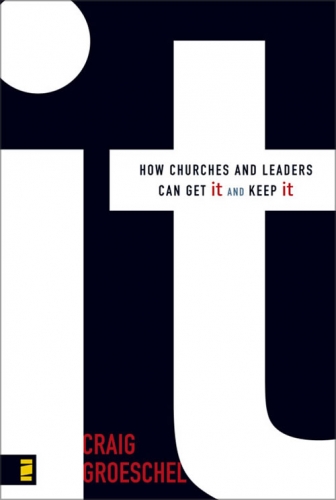
In his book “It, How Churches and Leaders can get It and keep It”, Craig Groeschel reminds us that every church has the Holy Spirit.  However some churches are able to take what God has given them and make it spectacular.  It is the same with musicians who have the X Factor; anyone can play music but some singers have that extra something that sets them apart.

So here are six suggestions, based on Groeschel’s book, on how to get it and keep it:

  1. Vision – without a vision a group will perish.  The same is true with your ministry.  If you want to get it, the X factor, then you have to know where you are heading and why.
  2. Divine focus – Groeschel suggests that if you chase two rabbits you will miss both.  If you want your ministry to grow then you have to narrow the focus.  Ask God for divine inspiration about what your ministry should really focus on.
  3. Camaraderie – those ministries that have it, the X factor, have a friendship that draws you in; you want to be a part of their group.  It is important to be serious about sharing life together and having a lot of fun together as well.
  4. Innovation – these ministries with it, the X factor, don’t make excuses as they find a way to do ministry with what they have.  God often directs by what He doesn’t provide.  Turn what you don’t have into an opportunity and a strength.
  5. Failure – Groeschel says that failure is not optional, it is essential.  Those ministries that have the X factor try things and are prepared to fail in order to be effective.  When a ministry plays it safe you can tell and people don’t join ministries that stagnate to play it safe.
  6. Outreach – ministries that have it, the X factor, don’t want to keep it a secret they want everyone to know.  These ministries will reach out into their community rather than looking to keep their current members happy.

The most important thing to remember is that it is not about the building or the budget.  In his book Groeschel says that the days when his church met in a double garage with no money were some of the best ministry they did.  When a church gets better buildings and resources it can think that it can buy its way to success.  The Holy Spirit can’t be bought, it comes to those who believe the Gospel and have a heart for sharing this Good News.

My prayer for you is that your ministry can get IT, the X factor.  And if you have the X factor my hope is that you can share it around because there are a lot of ministries that would like some.

———-

For a sample of the “It” talk by Craig Groeschel at the Global Leadership Summit click here.

markoffaith, mark of faith, Mark of Faith, MarkofFaith, markoffaith.net

A Bible reading plan for Parents with little kids

Parents – what if I told you that you could find 20 minutes in your busy schedule each day to read the Bible?  You would most likely say that you are too busy running around being a parent to have 20 minutes for “quiet time”.  Whilst most parents of little kids find it hard to get quiet time, they need it to keep them sane.  So what if there were 20 minutes within your parenting time where you could read the bible or any other spiritual reading?

When I was a young parent I found it frustrating putting my boys to bed each night. It would take almost an hour as I put them in bed, they got out, I put them back etc etc.  Then I learned a simple technique from the SuperNanny that involved sitting in the room whilst they were in bed without giving the child direct eye contact.  Her suggestion was based on the thought that the child is seeking comfort and gets security from knowing their parent is in the room.  Once you establish that you are not there to interact with them in a playful way, the child will go to sleep.  Whilst it doesn’t work perfectly I did get results from this technique.

What I found was that my boys would stay in bed whilst I was in the room but get out if I left the room.  If I stayed in the room for too long would get bored with not looking at them so I started reading a book to fill in time.  After a few months I developed a pattern where I spent about 10 minutes putting them to bed then the next 20 minutes reading a book on the floor in the doorway.  This is where you find your 20 minutes to read your bible, read some spiritual classics or any other material you want.  In my case I worked my way through Visioneering by Andy Stanley.  Some nights I found myself sitting in the room long after the boys were asleep as I wanted to finish the next chapter of a book.

My encouragement to all the parents of young children is to use this technique to accomplish two things:

  1. Spiritual reading – if you think about how much spiritual reading you can get through in just 20 minutes a night it is a lot.  You will start to look forward to bed time each night because you get into the next chapter of your book.
  2. Sanity – instead of becoming frustrated with your children’s bed time, which every parent feels, you might have a way of bringing comfort to your child by being close to them while doing a little something to keep you in “adult land”.

markoffaith, MarkofFaith, Mark of Faith, mark of faith

Eye witness proof of Jesus

People often ask about the proof about the existence of Jesus, did you know that we have eye witness testimony of the existence of Jesus?  Yet why do so many people base their views on Jesus from writers from a different millennium?  Do they have factual evidence to reject the testimony of eye witnesses?  What are the claims of eye witness testimony in Scripture?

On Sunday night here in Melbourne, Channel Nine aired a television drama called “Howz that!”  It is a re-creation of the events surrounding the 1970’s split between the Australia Cricket Board and the cricket players, leading to the creation of World Series Cricket.  The interesting thing about the drama was the actors were portraying real people and their version of events.  In the week after the show aired most of the media were asking the real people about their version of events.  Whilst the show was exciting to viewers, nothing beats the testimony of a person who was actually there.

This got me thinking about the value of eye witness testimony to prove what happened at certain events.  At the same time I was reviewing commentary of 1 John and realised the weight of eye witness testimony in the Epistle.  So what is the eye witness testimony in the bible:

  • The Epistle of 1 John claims to be from an eye witness of the life and ministry of Jesus.  In the Epistle it claims that Jesus was the Son of God and really died on the Cross as an atoning sacrifice for sin.
  • The Second Letter of Peter, 2 Peter, also claims to be an eye witness to the life and ministry of Jesus.  Peter also claims to have seen and read the writings of Paul, and found them difficult to understand.  See 2 Peter 3:15-16.
  • The Gospel of Luke claims eye witness testimony of life and ministry of Jesus.  The author, Luke, also claims eye witness testimony of the life and ministry of Paul in the Acts of the Apostles.

Some modern writers claim that the Old Testimony prophesies about Jesus are so vague that they could mean anything.  Whilst I disagree with this perspective it still doesn’t change the fact that there are at least three written eye witness accounts of Jesus.  We also know that  these writings have been tested over the centuries and found to be as legitimate as any document from that period.  If you want more on this see the work of John Dickson from the Centre of Public Christianity.

So it really comes down to the question “why do people reject the eye witness testimony of Jesus and get their understanding of Jesus from a 20th Century atheist?”  We have to wonder if it is because the message of Jesus is too confronting for them.  Perhaps the message of Jesus demands too much change in the way these people live their life.  Just because a person don’t like a message doesn’t make it untrue.

markoffatih, MarkofFaith, mark of faith, Mark of Faith, markoffaith.net